Saturday, March 31, 2018

Two new titles, free for 90 days!

I was rather over-busy last year, I had to have some eye operations, so there wasn't much time for botany, and publishing books had to take a back seat for a while as well.

However, we're back on track now, me and my books, and I've published two more in the last couple of weeks.

Firstly, Viburnum; possibly more garden-based than field-based, but you'd be surprised how many times these pop up in hedgerows, as part of the landscape planting in industrial estates, and particularly in the communal areas of housing estates.

Free to download now from Amazon, if you have Amazon Prime or Kindle Unlimited.


Secondly, Elms: I finally got around to finishing what has to be one of the most frustrating Cribs that I have done so far.

Elms are a very difficult group, as they hybridise very freely, and even the so-called authorities of botany don't know for certain how many species there are - "between 30 and 40 species" seems to be the generally accepted number - and that means there isn't a simple list of species, nor are there good clear descriptions of each one!

So for this book, I concentrated on the ones you are most likely to find when out and about, with plenty of reminders that what you see might not necessarily match exactly with any of the descriptions you might read.

Hopefully, though, by the time you've read this book you will know what you are looking for, and the next time you chek out your local hedgerows, you will be able to spot the Elms, and understand a bit more about how they grow and why they are there.

Thursday, January 5, 2017

Tree ID courses in London this year

If anyone is interested in learning more about tree ID, here are a couple of courses being held by the FSC (Field Studies Council) in Bushy Park over the next couple of months:

Saturday February 25th 2017: Tree ID in Winter for the FSC:

This is suitable for complete beginners: even if you can't really recognise trees in summer, you can still learn to do it in winter, and just think how much easier it will be once they have leaves! A short one-day introduction to the subject, we will spend the morning doing "Identifying", by working through the keys in the FSC's own Guide to Winter Trees, then in the afternoon we'll be doing the short-hand version, "Recognising", using my Cribs: and yes, you get to keep the Crib afterwards!

If you can't make the date or location, check out my book on the subject, Winter Tree ID, free to download if you have Kindle Unlimited or Amazon Prime, and only a few pounds, if you don't.


Saturday March 18th 2017: Introduction to Conifers for the FSC:


If you think you know nothing at all about Conifers, this is the course for you! It's a one-day course, with a lot to cover, but by the end of the day you will be able to recognise most of the commonly-found Conifers in the UK to genus level. No, not genius level, genus level - being a genius would take more than one day...  if you can't make the date or the location, this course is based around my book Conifer Basics, which is an easy introduction to a difficult subject.


Saturday March 25th, 2017: How to Be a Self-Employed Gardener for the WFGA:


A chance to ask me any questions you like about starting up in business: having done it myself, and having quite literally written the book on this subject - How To Be A Self-Employed Gardener, to be precise - I am always happy to talk about it, and to answer questions, to encourage more people to take this step and become self-employed as Gardeners. Even if you are already self-employed, this workshop will help and encourage you to take it to the next level, to be better: and to charge a realistic rate for it!


Saturday May 20th, 2017:  Introduction to Broad-leaved Trees for the FSC:


An easy introduction to our common street trees: if you struggle to spot an Oak from a Sycamore, this course will show you what to look for and how to use a Key to narrow down the options.


Saturday, November 19, 2016

Field Guides: yes, still going!

Well, it's been a while since I posted here, but I am still producing Field Guides, and I'm nearly half way through publishing the whole set.

The latest one came out two days ago,

...and as the title would suggest, it's a guide to identifying the various Redwoods that we have in the UK.

I find that their names are so contradictory - if Sequoia is Californian Redwood, then surely Meta-sequoia ought to be Giant Redwood, yes?

No. It's Dawn Redwood, the deciduous one.

Giant Redwood is Sequoiadendron.

With this confusion in mind, I made a Crib for them, and I still have to refer to it every time I look at these trees, as I seem to have a complete blind spot for this family!

Anyway, the book is now out, here's a direct link to it, or you can go to my Author Page and check out the whole list.

As always, these books are FREE to download if you have Amazon Prime or Kindle Unlimited, and it doesn't even matter if you don't have a Kindle, as Amazon kindly provide a free programme ("app") to allow you to download them to your pc, laptop, or other device.

So there you are, no need to ever be confused about Redwoods ever again!

Sunday, June 5, 2016

You know you're a Botanist when...

.... you look up how to make an origami Bellflower, you successfully make one:


And then you look at it in dissatifaction and say "but Bellflowers have five petals...."

*sigh*

Note: when I say Bellflower, I mean Campanula.

Thursday, February 4, 2016

Free Field Guide this weekend: Poppies

Rather out of season, but I was writing an article on Poppies the other day, which prompted me to finish this Field Guide, which I started last year and never quite got around to publishing.

Everyone knows what a Poppy is, but are you sure it's Papver rhoeas, or is it P. dubium?

And what about Welsh, Horned and Californian? Would you recognise an Opium Poppy if you saw one?

Here it is, then, the answers to all these questions and lots more information about Papaver and "other things called poppies", all in one neat package, for less than the price of a cup of coffee, but FREE this coming weekend.

Amazon work on US time, by the way, so although it is free from midnight on Friday night, in the UK it won't appear to be free until about mid-morning on Saturday, and will continue to be free right over into the small hours of Monday.

And of course if you have Kindle Unlimited, or Amazon Prime, then you can download it for free at any time ("whoopee!"), but if you don't, then hang on until the weekend and get it free then.

If you don't have a Kindle, that's not a problem, Amazon kindly provide a free programme ("app") so you can download it to your own device, and if you don't have a tablet, it still doesn't matter as you can even download it to your PC or laptop.

 As I said last time, if you have any comments on the book, do please email me on rachy.ramone@gmail.com, as I love to hear from people who have used the Cribs, and quite often there are good suggestions which I am very happy to incorporate. Also, if there is a group of plants that you are struggling with, do let me know as there might already be a Crib for them, in which case I will bump it up the publication list: I still have over 30 or so to do, and as I work full time, it is taking me quite a while to get through them all: let's hope for a couple of rainy weeks when I can't get out to work..... *laughs*

Finally, if you like it, do please leave a Review on Amazon, as that will encourage other people to download it.  

Tuesday, November 17, 2015

New Field Guide out: Free this weekend!

Last week I finished uploading and publishing another of my Field Guides, this one is for the slightly esoteric selection of Acacias:  trees that look like Acacias, that are called Acacias, and that have pinnate leaves and spines, and which might get confused with Acacias.

But Amazon made a slight bish with the cover:

Can you spot the mistake?

Yes - *sigh* - they used the Scabious cover.

Dratski!

I waited a couple of days for them to sort it out, but a sorting out was not forthcoming, so in the end I had to unpublish the book, then create a new listing. However, it was not all a bad thing, as I spotted a spelling mistake, and then I looked at the next paragraph and thought that, actually, I could reword it to make it a bit easier to understand.

Anyway, it is now done, and available for FREE download if you have Kindle Unlimited or Amazon Prime: and if not, well, it's only the cost of a cup of coffee,  and you need never again be confused by this group of trees.

However, as I like to spread the good word of Botany amongst my fellow iSpotters, I'm offering it FREE this weekend, Sat/Sun 21st and 22nd November, so hang on until then.

Oh,  and talking of the principle of free download weekends, I have noticed that Amazon, being an american company, have a rather jingoistic approach to their timekeeping.

So when I say "free on Sat/Sun" it will actually start being free when America starts the day, which is roughly 5 hours after we do... and it will continue to be free on Sunday night, long after midnight.

I expect to see, over the next few weeks, a whole pile of iSpot Observations of this group of trees!


Sunday, October 4, 2015

New Field Guide out today - Wild Roses

There have been a few iSpot Observations recently dealing with Field Rose, Dog Rose etc, and it seemed that quite a few people were not entirely sure of the differences, so here we are:

...my Field Guide to the commonest wild roses that you are likely to find whilst out and about in the UK countryside.

It's available now, HERE, on Amazon.

As always, these Field Guides are not intended to replace proper botany reference books, they are intended to provide a quick and easy reference resource for differentiating between each group.

I found this Crib to be a very easy one to write: once I got started, I found that the differences in the wild roses are actually very straightforward, unlike the pesky Veronicas (a book that I am going to revise almost immediately after publishing it, as I think it could be clearer..), but this one is nice, very easy to use.

As always, if you have Kindle Unlimited, or Amazon Prime, then you can download it for free at any time ("whoopee!"), but if you don't, then hang on until next weekend and get it free then.

Yes, it will be FREE to download next weekend, the 10th and 11th October.

If you don't have a Kindle, that's not a problem, Amazon kindly provide a free programme ("app") so you can download it to your own device, and if you don't have a tablet, it still doesn't matter as you can even download it to your PC or laptop.

You can't get any more helpful than that!

If you have any comments on the book, do please email me on rachy.ramone@gmail.com, as I love to hear from people who have used the Cribs, and quite often there are good suggestions which I am very happy to incorporate. Also, if there is a group of plants that you are struggling with, do let me know as there might already be a Crib for them, in which case I will bump it up the publication list: I still have 40 or so to do, and as I work full time, it is taking me quite a while to get through them all, but I hope to have them all published before the end of the year.

Or maybe before the end of next year.... *laughs*

Finally, if you like it, do please leave a Review on Amazon, as that will encourage other people to download it. 

Saturday, August 15, 2015

Speedwells - FREE again this weekend

This one was so popular that I'm offering it free again this weekend, 15th and 16th August.


They are not a particularly difficult group, but it's nice to have all the details in one place.

And remember - if it has five petals, it's Myosotis, which is Forget-me-not!


As always, if you have Kindle Unlimited, or Amazon Prime, then you can download it for free at any time, but if you don't, then hang on until the weekend and get it free then.

If you don't have a Kindle, that's not a problem, Amazon kindly provide a free programme ("app") so you can download it to your own device, or even to your PC or laptop.

Give it a go, it's really easy!

And then this weekend, you can rush outside and start searching for small blue flowers to ID.

If you have any comments on the book, do please email me on rachy.ramone@gmail.com  and if you like it, do please leave a Review on Amazon, as that will encourage other people to download it.

Friday, June 5, 2015

FREE guide this weekend: Bryony and Nightshades

Can you remember the difference between Black Bryony and White Bryony, two climbers commonly found in hedgerows?

Do you know which of them is poisonous? (Trick question - they are both poisonous!) And can you tell the difference between the two bryonies and the nightshade which is also commonly found climbing in hedgerows?

What about the Nightshade family - one of them is edible, but the rest are toxic, can you tell the difference?


All these questions and more are answered in the Field Guide to identifying Bryony and Nightshades in the UK, available on Kindle from Amazon.

It's FREE this weekend, Sat/Sun 6th and 7th June,so download it for free: and don't worry if you don't have a Kindle, it will work on any tablet, and if you don't have a tablet, you can download it to your PC, so there is no excuse!

Amazon generously provide a free programme, or "app"  to allow you to view Kindle ebooks on your pc, it's very easy to install it, and then you can read not just this one, but any of the other Field Guides which I have published.

There are more than a dozen of them already out there, and I am working through the others - 57 at the last count, and the list keeps on expanding - as and when I get the time.

If you have Kindle Unlimited, you can download all of them for free, every single one: but if not, try this one as a taster and see what you think.

And if you like it (which I hope you will) and find it useful (which I am sure you will) then do please leave a review.

To find it,  click on the link above, or go to the Amazon Kindle store and type in Field Guide UK to see the current list.

As I have said before, these Cribs are for Beginners, and Improvers. They only cover commonly found species, and they cannot replace a proper Field Guide such as Poland or Rose: they are intended to be an easy-access, non-off-putting way to present the salient information in an easy-to-read format, to people who have gone beyond having to key out every single plant, and who are trying to learn the difference between species.

So get out there this weekend, and check out your local hedgerows!

Thursday, May 14, 2015

Field Guide to Speedwell: FREE this weekend

Yes, it's that time again, time to publish another Field Guide.

This time I have turned my attention to Veronica: not a particularly difficult group, but it's nice to have all the details in one place.

And remember - if it has five petals, it's Myosotis, Forget-me-not!


As always, if you have Kindle Unlimited, or Amazon Prime, then you can download it for free at any time, but if you don't, then hang on until the weekend and get it free then.

If you don't have a Kindle, that's not a problem, Amazon kindly provide a free programme ("app") so you can download it to your own device, or even to your PC or laptop.

Give it a go, it's really easy!

And then this weekend, you can rush outside and start searching for small blue flowers to ID.

If you have any comments on the book, do please email me on rachy.ramone@gmail.com  and if you like it, do please leave a Review on Amazon, as that will encourage other people to download it.

Friday, March 13, 2015

Free Field Guide to Violas, this weekend

Yes, iSpotters, yet again I am giving away a free Field Guide this is the one for Violets and Pansies, an interesting little group, not particularly difficult, but much easier with this Field Guide to hand:


As you can see, it's free all the time if you have Kindle Unlimited, but it will be free to everyone this weekend, 14th/15th March.

Here's the link to the Field Guide to Violets and Pansies

Do download it if it you get time, then get out there and find some Violets to botanise!!

Friday, March 6, 2015

Oak Field Guide: FREE this weekend!


All these Field Guides are free to anyone with Kindle Unlimited, but this weekend - 7th and 8th March - this one is free to everyone.

It doesn't matter if you don't have a Kindle, as Amazon provide a free "app" (or "programme" as we grown-ups call them) which allows  you to view Kindle books on other devices, and even on  your own pc.

I've tried this, and it really works!

Of course, the point of publishing these Field Guides to Kindle is for people to be able to take them outside with them, on a mobile device, but there's nothing to stop you reading them indoors, then printing off the Table of Difference and taking it out and about with you - after all, that's what I do, with my pack of cards, the original version.

It's a bit early in the year to be looking at oaks, but now's your chance to download this one for free.


Thursday, February 19, 2015

Next FREE Field Guide - Cornus V Buckthorn

I've been galloping ahead with this publishing lark, it's not so bad once you get into the swing of it.

This weekend I'm offering a FREE download of the latest one:


This one is a neat round-up of the diagnostic features of the commonly-found opposite-leaved shrubs.

Quick and easy to check, it saves having to wade through the detailed botanical descriptions in Rose, Poland etc while out walking or botanising.

Just the salient features, presented in a simple grid format.

All my Field Guides are free to download if you have Kindle Unlimited, or Amazon Prime, but if you don't have either of those (or a Kindle for that matter!) you can still download it for free this coming weekend, 21st and 22nd Feb, and you can also download the "app" (or "programme" as we grown-ups call them) to enable you to read Kindle books on other devices, or on your own PC.

As always, they are aimed at Beginners and Improvers, and I strive to simplify without dumbing down. 

The weather forecast is good for the weekend, so get the kids, get out there, get botanising!

Thursday, February 5, 2015

The Cribs are being published!! Free this weekend!!!

Finally, after months of nagging from my Botany Crew, I have found a way to publish the cribs at minimal cost.

Here's what they used to look like:


... quite literally a pack of cards, hand-written initially, then transferred to the pc,  printed out and stuck to the card. It works beautifully: I can annotate them, then update the printed version.

However, three weeks ago I was introduced to the wonders of the Kindle, and now the cribs are being published electronically: here's number 34 (boy, have I been busy!) and to find it, you just go to Amazon's Kindle eBook page and type in "field guide hellebore" and there it is: once you have found one, just click on the author's name to see all the ones currently available.


They are not all available yet: it takes a while to get each one uploaded, and every time I revise anything they come off the "live" list, but I'm working my way through them whenever I get time.

They are currently priced at £1.99 each, which is the minimum price I can set, but to get round this, I
have devised a cunning plan: each month, for the first weekend of the month, there will be Field Guides offered for free download.

Amazon restrict me as to how many "free" days each book is allowed to have, but I'll try to rotate the titles on offer, so you have a good chance of getting whichever ones you want, for free.

Please bear in mind these are for Beginners, and Improvers. They only cover commonly found species, and they cannot replace a proper Field Guide such as Poland or Rose: they are intended to be an easy-access, non-off-putting way to present the salient information in an easy-to-read format, to people who have gone beyond having to key out every single plant, and who are trying to learn the difference between species.

In fact, they are for people who have gone beyond "It's a Willowherb!" and have reached "But which one?"

This is where these little Field Guides come in: once you are confident enough to recognise that it's a (for example) Willowherb,  you can save time wading through the in-depth botanical descriptions in Rose, Poland, Stace etc,  and merely take a quick look at the Field Guide on your Kindle, which has all the salient information neatly laid out in a grid, so  you can quickly and easily check which characteristics your plant has.

It drives me mad, the way that none of the guides present the information in the same order, even on the same page of their book: and frequently I have had to have three or four reference books open at the same time, as well as extensive internet research, in order to round up all the information required.

And if you don't have a Kindle? Apparently, that doesn't matter, you can download them to your PC, or to other devices, with the help of a simple "app" (or "programme" as we grown-ups say) which Amazon kindly give away for free. Also, if you are a member of Kindle Prime (or some such name) then you can download for free, and I rather think there is another layer of Kindle reading whereby you can "borrow" an eBook for a short time: I think that's a subscription thing, but if you have it, you'll already know about it.

So there you are, the Cribs are/will soon be available, this coming weekend 7/8th Feb will have two books for FREE, Hellebores and Tilia (Limes): do please check them out, use them, annotate them (Kindles are brilliant, you can make notes on your eBooks!) make them your own.

If you spot any mistakes, do let me know: and if you have any feedback or criticism, I'd be pleased to hear it.

Tuesday, October 21, 2014

Mystery Conifer

Today's Mystery Tree: a conifer, from Harcourt Arboretum, unlabelled.

Overall tree shape (right)  shows branches ascending at tips.

Last year the foliage on this tree was so dirty - covered in algae, soot, road dirt etc - that we were unable to ID it, we were not even certain what type of conifer it was.

Usually the leaf attachment tells you what genus you are looking at.

In this case we thought last year that the leaves had green petioles (stalks) and it was therefore a Tsuga, and we keyed it out to be Tsuga dumosa (Himalayan Hemlock), but we were not completely convinced.

This year, there was a whole spread of new, clean foliage and we now thought we could see cones in the upper branches, and they were standing upright above the branch, which would suggest Fir (Abies), rather than Tsuga.

The cones (which I could barely see) appeared to have projecting bracts, and to be squat, and dumpy (Two of the less well known dwarves).

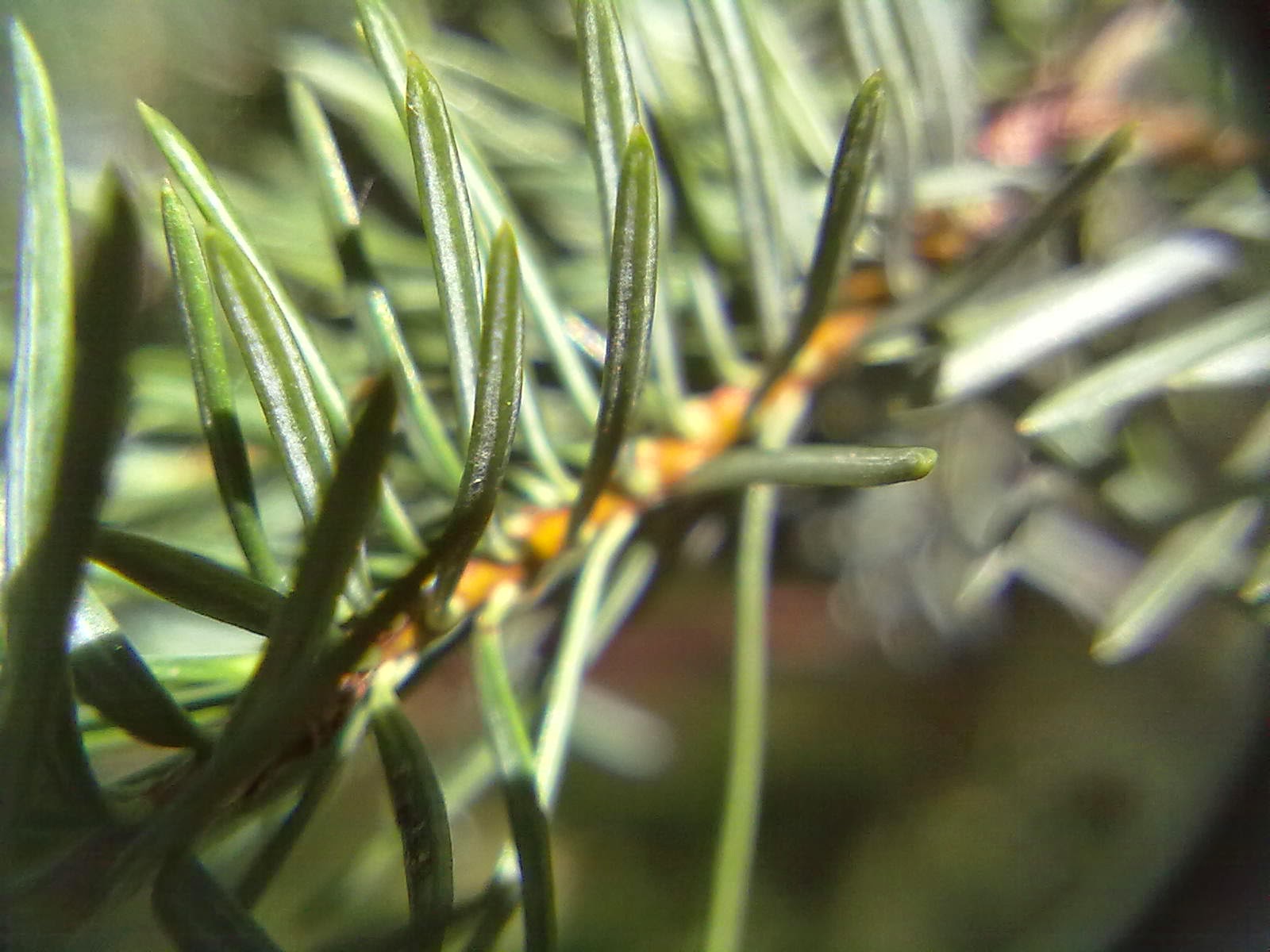
A close look at the cleaner foliage suggested it might indeed be Abies, especially when the removal of a couple of leaves left what are clearly round leaf scars:

Leaf scars
Here you can see I have pulled off a couple of the leaves, revealing round leaf scars
Looks like petioles


And you can see why we would have thought it was a Tsuga, these leaves look just as though they have a slightly twisted, green, petiole.


Bark

Stem
Here's a shot of the bark - I never find bark to be useful in ID, but maybe you will.


And here's a close-up of the stem, which I would define as glabrous, ie not hairy.


As opposed to glaucous, meaning blue-ish.

I keep getting those two confused.
Leaf tips


Leaf tip close up - not notched.

Most Abies species are notched at the tip - the usual exception is Abies concolour, White Fir. But they have leaves the same colour on both sides, which is not the case here.

Mind you, they do appear to have stomatal bands on both surfaces, although they are much broader, whiter, and more clearly defined on the underside.


Trunk

A shot of the trunk, in case it helps.


Underside


Showing the underside of the leaf, two wide stomatal bands visible, plus you can see there is a parting underneath, but not a totally clear one.


The leaves, when crushed, had a faint citrus smell - I thought it was grapefruit, but I'm not good at putting names to smells.


Finally, here's a shot of the bud at the tip of a shoot.

I would describe it as yellowy-green, and resinous.

This shoot is twisted round so it's almost upside down - it shows the parting underneath the shoot, being clearly a parting, but not a completely clear parting, if you see what I mean.

We keyed this one out to be Abies delavayi, but the leaves are not curled back along their margins.

We're confused!

Sunday, October 12, 2014

Scots Pine ID test

If you think you have a Scots Pine (Pinus sylvestris) ..... you would be looking at a conifer with one single main trunk, and at the upper levels, the bark is often quite orange. Get a sample of the foliage from a low-hanging branch - if you can't reach the branches, check around the base of the tree for fallen branches with fresh foliage.

Firstly, how many needles are there in each bunch? If more than 2, it is definitely not Scots Pine.

If they are in twos,  are they long and slender, or short and stout?

If they are more than 3" (about 75cms) then they are not Scots Pine.

If they are 3" or less, are the individual needles straight, or twisted? And what colour are they - glaucous (bluish grey)? Or fresh green?

If they are straight and glaucous, there's a good chance it's Scots Pine.  If they are twisted and clear green, they are not: they may be Pinus contorta, Lodgepole Pine. I assume that the "contorta" bit refers to the contorted needles, so that's an easy one to remember.

So if you have short (less than 3") needles in pairs, straight, and glaucous, you may well have Scots Pine.

Now for the ID test:

Take one of the needles and pull it apart (grip one end in each hand and pull steadily until it rips). Is the break a clean break, or is there a tuft of fibres sticking out from the broken ends?


Here's a close-up of one I ripped apart earlier:

Can you see the tuft of fibres?

Think of them like a beard... Scotsmen are often depicted in silly stereotyped cartoons as being red-headed, red-bearded figures, so if you combine the redness of the trunk and the "beard" of fibres, well,, there's a way to remember it.

Scots Pine - red, and bearded. Red bark, and a "beard" of fibres if you full a needle apart.

Now get out there and start destroying pine needles! *laughs*

Sunday, December 22, 2013

Introduction to Conifer ID

ID of Conifers is a large and complicated subject, but I recently lead an informal Intro to Conifer ID botany  outing which was very well received.

I'll be doing it again in the New Year, but for the benefit of  iSpotters who don't live in South Oxfordshire (!) here are the basics. Do bear in mind that this is a simplification of a complicated subject!

Before we start, if you wish to learn about conifer ID you really will need a hand lens - a x20  is best, but a x10 will do if that's what you have. They only cost a few pounds for the normal folding type, and the advice to hang it round your neck on string or ribbon really is a good one - it may feel a bit geeky, but if you don't, sooner or later you will put it down in the long grass and lose it. Ask me how I know.. yes, I did it.

And you have to remind yourself of the First Rule Of Botany, which is "Common Names Are Misleading". Closely followed by "and the proper or scientific names keep changing - no use grumbling about it, just deal with it".

Right, here we go.

When we look at trees in general, we split them into two types - they are either Broadleaf or Conifer.

Broadleaf trees have - as you would guess - mostly wide leaves, mostly with veins in a net formation. Conifers have linear leaves: the veins run parallel along their length.

Some people  prefer to call them Deciduous and Evergreen.

Like everything in Botany, its not quite that simple:  some Conifers are deciduous (Dawn Redwood, and Swamp Cypress for example) and some Evergreens are not Conifers - Holly, for example, or Box.

 But it will do for a start.

So, Winter is a good time to look at Conifers/Evergreens, as they are (generally speaking, allowing for the exceptions mentioned above) the green ones, making them easier to spot.

When we look at Broadleaf trees in summer, our first point for an ID is the arrangement of the leaves - are they opposite or alternate?

When IDing conifers, we don't initially look for the arrangement, we firstly look for the type of leaf.

Conifers have three types of leaf  - needle, flat, or scale.
(As always, this is a simplification, but you have to start somewhere)

Needles are, as the name suggests, round and pointed. Pine are the obvious ones.
Flat leaves are generally long and thin, but are flattened - Yew would be the most familiar one.
Scale leaves require a hand lens to see clearly - things like the infamous Leylandii have scale leaves.

So the first thing you do is look at the foliage, and decide if it is a needle, a flat leaf, or a scale leaf.

Group 1) Needles.

These are needles - long and thin.

When looking at needles, the first thing is to count how many there are in each bundle.

Check several bundles to ensure you didn't pick an aberrant bunch... they are generally found in 2s, 3s, or 5s (these are all Pines or Pinus) or in clumps of 10 or more - which means Larch (Larix) or Cedar (Cedrus).

So already you have learned an easy ID trick: if confronted with needles, if they are in bundles of 5 or less, you can say with confidence "it's a Pine."

If in 10 or more, is it Larch, or is it Cedar? In winter it is easy to tell - Larch are deciduous, Cedar are not. So if the ground underfoot is covered with dead needles, and you had trouble finding a branch with any good foliage on it, it's Larix. As a broad generalisation, Cedars are stately, shapely trees, often planted in gardens or parks as individuals. You rarely find Larch all alone - it's a cash crop, fast-growing, so it's usually found in plantations - rows and rows of them all together. In addition, Larch have small cones, which tend to stick to the branches even when the needles have fallen, plus they have a habit of shedding branches, so in a Larch woodland, you will usually find plenty of twigs and branches on the floor, all with a number of small cones still in place.

Cedar, on the other hand, have large oval cones which do not fall - they shatter over time, on the tree, so you hardly ever find a compete Cedar cone, you normally only find individual scales:


Group 2) Flat leaves.

Long and thin, but flattened. They usually have two lines of whiteness underneath - these are stomatal bands, or bands (stripes) of stomata, which are the pores through which a leaf breathes. They often show up as silvery against the green leaf, but as so many Conifers have them, they are not all that much use in ID.

This group includes the familiar garden Yew, the exotic Redwoods, the less-familiar Tsuga, and everything we think of as a Christmas Tree,  including Firs (Abies) and Spruces (Picea). It also includes my personal favourite, Douglas Fir, which is not a Fir at all. More of that later.

Picea omorika - Serbian Spruce
This is a hand-lens close-up of Picea omorika or Serbian Spruce.

As you can see, long thin flat leaves, and lots of white stomatal bands.

The way the leaf is attached to the stalk is a major factor in IDing this group of Conifers, so we will look at that in more detail later.

So far, I have not been able to come up with a catchy name for Conifers in Group 2, so if any of you out there know of something, do let me know, otherwise I shall have to make something up, and that is simply "not done" in botany.


Group 3) Cupressaceae.

There you go, a nice new word for you to learn. Koo-press-ay-cee. Think about the "press" part of the name, as it contains the clue to this group - it's those with scale-like leaves, or leaves which have been "pressed" against the stem.

As mentioned at the start, it's a generalisation, but the term Cupressaceae can be taken to cover most of those Conifers that don't have either needles or flat leaves. This means (she said with a straight face) that you can look through your hand lens at the foliage and say, solemnly, and instantly, "It's a cupressaceae"  which will impress all non-botanists. In fact, you can probably look at a conifer from about five paces, see that it's neither needled nor leaved, and say knowingly "Ah, looks like a cupressaceae from here, but of course without my hand lens I can't tell you exactly which one."

Here's a random selection from the internet:


As you can see, they are all somewhat flattened, the branchlets tend to be in one plane - pressed, you could say, Koo-PRESS-ay-ceee -  and the smallest twigs are almost rope-like.

At first, they all look the same, but once you start looking through your hand lens at this group, you will start to see the differences - honestly!

They are a difficult group - but some are easier than others, and some have a strange beauty all of their own, when viewed through a hand lens: here is a close-up of some Calocedrus decurrens or Incence Cedar.

Please note, as per opening statement, that this, along  with Thuja plicata or Red Cedar, is not actually a Cedar. Cedars are in the genus Cedrus, and they have needles... I know, I know, you just have to learn to call them by their proper names.

And these strange spiky-looking things, left, are actually common or garden Lawson Cypress, as seen and photographed through a hand lens.

Amazing, aren't they?

Well, that was the briefest of introductions to Conifer ID, explaining the three main groups or types of conifers. Having grasped that idea, we can now start our walk up to the conifer area (heh heh, secret location) to put it into practice.

We will be watching the ground as we go, to see what is fallen: cones and needles are usually very visible, and give us good clues as to what is above.

We look at the foliage and decide if they are needles (if so, how many), or flat leaves, or scale leaves. This gives us a head-start to know which genus the Conifer is likely to be.

And that is quite enough for one post - next time we will look at each of the three groups in more detail.

Friday, July 5, 2013

Digital microscopes...

Alyson was asking about Digital USB Microscopes, and would you believe, I actually have one.

One of those terribly embarrassing things where someone kind asks what what you'd like, you say "Ooh, ooh, a DUM please," they buy you one, you use it for five minutes, then put it in a drawer...

I've just dug it out again, and taken photos of a couple of leaves, both with the DUM and with my hand-lens-and-cheap-mobile-phone trick.


Item one: Common Lime leaf with nail galls.

Taken with DUM, which has its own built-in light.


2: same leaf, using hand-lens x20 and the light from the DUM.

Ah, I'm not actually in the same place on the leaf, so that's not a very good comparison, sorry, but it was so beautifully in focus that I felt I had to include it.

Focusing is a bit of an issue in both cases - more below.
 Right, same as top picture, the fork in the veins, one big one, one liddle one, not quite at the same angle.

Again, hand-lens, this time using its own in-built light.

 .


 This is a pear leaf with damage and browning, taken with the x20 hand lens.


This is the same leaf, with the DUM. Much better definition on the small veining.

Regarding focusing, each method has problems.

As mentioned in the Amazon review for the DUM, the stand it comes with is not particularly good. It would be a worthwhile investment to get a better one.

I found that you have to hold the body of the DUM in order to twist the focusing ring, then when you release it, of course it's not quite in focus any more. It takes a bit of practice to get it right, and it's a shame they don't have a mouse-operated digital focus for it.

The hand-lens is simpler, but again it's sometimes difficult to get the focus just right.

In both cases, I imagine that practice would make, well, if not perfect, then a lot better.

The DUM is advertised as being 10x -200x, but I did not find a way to select the magnification - it was more a case of twisting the zoom until the object became sharp. But I haven't used it for aaaaages and there might be more instructions on the CD that came with it.

Hope this helps!

Tuesday, June 11, 2013

Tilia crib for Pete


Hi Pete, *waves*

As discussed, the ID of Lime trees - Tilia -  is really difficult as they hybridise so freely. The books say that there are three main types: Common, Large leaved, and Small leaved, with Common being a hybrid of the other two. Plus a few more ornamental varieties, but I don't worry too much about those as they are not likely to be found outside of parks and aboretums. Arboreta? You know what I mean.Oh, and disregard the phrases "large leaved" and "small leaved" as the size of the leaves is NO sort of indicator, annoyingly!

Be warned, they continue to hybridise, so there are in fact a wide range of hybrids, all shading from closer to one, than the other. So they don't always fall neatly into their category.

Having said all that,  I made a crib, or Table of Differences, for Limes last year (or was it the year before?) which now seems a bit basic, but it might get you started on creating your own crib:


As you can see, very simple: it's not a key, simply a collection of relevant ID points all in one place, for the three main Limes plus the one that I've encountered locally - of course, you are most welcome to add as many other species as you wish, I restrict mine to commonly occurring species, in order to keep them down to A6 size for my  famous Botany Cribs pack  (which certain members of the Midweek Botany Crew keep trying to steal). They usually start out hand written, but after an Incident on a rainy day, I decided to copy them all onto spreadsheet format, so that I had a permanent copy at home.

This has proved to be a very good way of doing it: I print them out and stick them onto the index cards, I can then annotate while out in the field, then at home I update and reprint every so often. And when they get too wet to read, I just print off new ones.

Here's my battered pack:


Hope this gets you started - the idea is that you fill in any gaps, and add more features as you discover them. Obviously I don't bother with any features that they all share, just in features that help to differentiate.

When you come across a tree that doesn't quite fit any of the categories, then you have to turn to the reference books, but at least the crib can cut down the number of times you need to do that.

Have fun!


Monday, January 28, 2013

Hello, iSpotters!

I live in South Oxfordshire, and I'm a Professional Gardener, Horticulturalist and Botanist, competent at IDing garden plants, trees and shrubs, and pretty much all of the vascular plants found in woodland settings.

Wild flowers, however, were something of a closed book to me, until a couple of years ago, when I started getting interested in them as well. Up to that point, professionally, they were all just "weeds" and to be dealt with in a particular manner.

However, I'm now extending my ID skills to include wild flowers. This has meant a whole heap of wandering around lonely fields and hedgerows with a reference book and a hand lens.

I belong to the Oxford Botany Email Loop, a loose collection of botanists in and around Oxford, who meet up from time to time to carry out surveys, or just for the pleasure of botanising.

Over the past few months I've also been introduced to iSpot, which is a fantastic resource for plant ID. I find that I sometimes struggle to make an ID from a photo, especially when the photos are not very clear, or don't show the parts of the plant that I need to see. But it's very good practice, and it's nice to be able to share knowledge: there are some fantastically knowledgeable people on iSpot, and they are all very happy to explain  and encourage.

One quirk of iSpot is that they don't have a chat facility, and they don't allow individual messaging, so I've created this resource to allow people to contact me by email, at Rachy.Ramone@gmail.com if they want to.

I've also taken the opportunity to create three Helpful Hints pages for making better iSpot Observations, and I hope that you find them interesting and helpful.